
 By Wendy C
The first time I met Nonna was when my husband and I were dressed up in our finest for an event at which his entire extended family would be in attendance. I still remember that day. I had stepped out of the car and immediately felt two eyes piercing through me across the parking lot. I turned around to see an old lady staring inquisitively at me.
“Who is that lady, and why is she staring at me so intently?” I remember asking my husband.
“Oh, that’s my Nonna Stella,” he replied casually. “She just wants to know who her oldest grandson is dating.”
That was my very first impression of Nonna, and it wasn’t that far off from the woman I learned she was.
Nonna was the matriarch of a large Italian family. A formidable presence; she did not remotely resemble the dainty grandmother image I had read about in novels. She was robust, with a strong physical stature and a severe looking face that revealed a life of hardship and struggle I can’t even fathom. She was born and raised in a small town in Italy, immigrating to Canada in the 1960s with her four young children—four years after her husband. She did not have an easy childhood and was also not an easy mother to grow up with.
I discovered Nonna was a very strict mother, exacting in her treatment and expectations of her daughters. Her sons, however, were often doted upon. A similar sentiment seemed to be echoed by the older granddaughters in the family, but to a much lesser degree. Interestingly, my husband had a very different experience of his Nonna growing up, and perhaps this could be attributed to the fact that he was the first-born male of the next generation, a special status bestowed upon him automatically when he entered this world. His childhood memories often contrast those of his sister as he recalls a gentle, sweet Nonna who never once reprimanded him.
In the 15 years I got to know Nonna before her passing, I realized that as tough as her exterior seemed to be, she had a tender spot for her grandchildren, any of their significant others, and of course, the great-grandchildren. Hers was an open-door policy. No matter what time of day it was, she welcomed any of us who dropped by her house with open arms . . . and food.
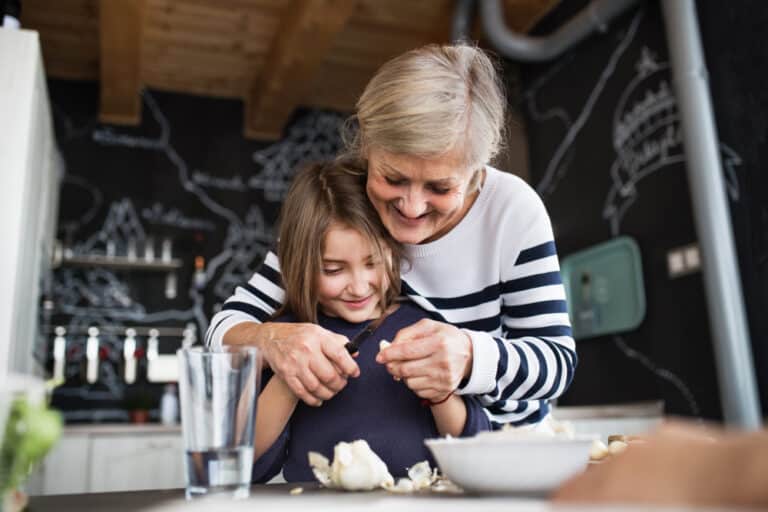
In fact, if food was a love language, it would be hers. She loved to feed us. Pasta? Meat? Pizza? Bread? Olives? Cheese? The moment you entered Nonna’s house, you would usually be greeted by the sight and smell of pasta sauce bubbling on the stove in a big stainless stock pot.
Most of the time, we grandkids did come for Nonna’s food, but even when we didn’t, we sat down at the table and ate anyway because to not do so is impolite in Italian culture. Once we had filled our plates, Nonna would sit across the table from us and ask about our lives. In her limited English, she’d inquire: How was school? How was work? Do you have a boyfriend or girlfriend? When are you going to get married? When are you going to start a family? Did you plant your tomatoes yet? (Nonna was an avid gardener.)
With the older grandchildren, the conversation at the table would often turn toward Nonna’s younger days. She would share stories of her youth, of what life was like growing up in Italy. She would even talk about her and Nonno and the things they did when they were younger. And sometimes without warning, she would break out in uninhibited laughter, and I’d realize that even though she was a Nonna, there was still that spirited little girl named Stella residing within her.
When it was time to bid adieu, Nonna always sent us off with a loaf of her homemade bread, a carton of fresh eggs from her chicken coop, and leftover pasta (in a yogurt container, of course). It was her way of making sure we didn’t go hungry and ate good food. If any of the grandchildren refused to take food home, she would insist until they eventually gave in because no one wanted to hurt her feelings.
For Nonna, the importance of “la famiglia” was undeniable. She wanted her family to come over and visit her often. She welcomed them anytime they showed up at her doorstep. And when they came? She fed them —abundantly. Food was her labor of love.
Having never really grown up with a grandmother presence in my life, I had a hard time fully grasping the bond my husband and his cousins had with their Nonna. I was always an observer, never quite the participant; not for lack of trying on my husband’s or his Nonna’s part though.
On the day Nonna passed away, my husband’s family broke. They had lost their matriarch—the glue that held the family together. The last binding piece (Nonno had died a year earlier) that kept the family coming back to the house they had spent their formative years in. No longer would they be able to taste her pasta or her pizza. No longer would they be sent home with a loaf of her bread, fresh eggs, or leftovers in a yogurt container. No more would they be asked by Nonna to sit down at the table and eat. Her kitchen was eerily silent the day the house went up for sale.
But in the time since Nonna’s passing, the family continues to get together over food and wine. Each grandchild now brings their own unique twist to the dishes she once used to make for them. And I’m pretty sure that makes Nonna Stella smile up in Heaven, knowing “la famiglia” is still going strong.