



Every day I pick my children up from school and ask the same question: Do you have homework tonight? I wince when their response is always yes.
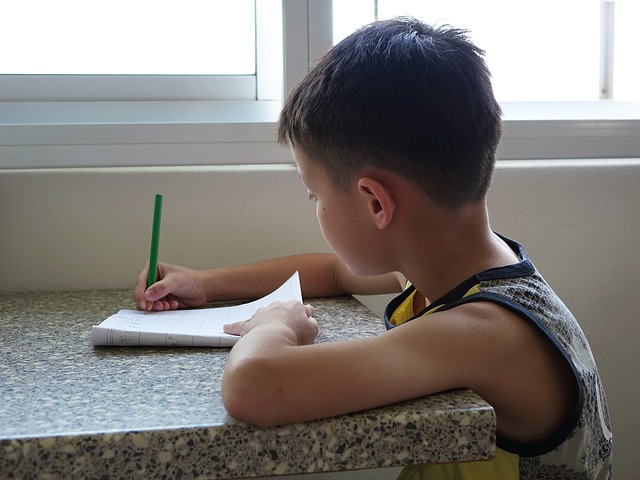
Homework in my house looks something like this: after a long day of school, my kids come home, wash their hands, and have a quick snack. The very last thing I want to do after working all day is more work. My brain is beyond the point of thinking, a consistency somewhere between mashed potatoes and cottage cheese. My children feel the same, but for some reason we all sit down at the kitchen table and brace ourselves. We start with the best of intentions: sharpened pencils and big, pink erasers at the ready. Inevitably, it’s just too much.
It starts with the famous pencil drop, a tactic my children employ as an excuse to get up. After all, they’ve been in seats all day. Usually around the same time my sister sends me a picture of a pencil on the floor at her house—no caption needed. I know the exact same scenario is playing out at her dining room table. Then, someone has to use the bathroom. Someone needs another snack. If one child is still attempting to focus on their work, the other makes sure they emit the most annoying sounds possible to deter their sibling’s efforts. I sneak off to see if I can boil a pot of water to get dinner started, but when I return to the table, it’s too late.
One of them has gone nuclear—resorting to the most fateful of homework avoidance moves—rolling around on the floor, dramatically reaching for whatever homework-related detritus has fallen—the pencil, eraser, worksheet—sometimes all of the above. It’s even worse when these items have been left on the table, when there is no pretense of an item to retrieve.
At this point, my enemy—the clock—taunts me. It reminds me that dinner isn’t ready yet. Staying up late is out of the question; I will always prioritize my children’s rest. On top of it all, we have soccer practice. My husband and I are the coaches, so we have to get there early to set up. It’s my turn to bring the fruit snacks—do we even have fruit snacks?
I start to sweat and claim that we won’t go to soccer, which my kids know is an empty threat since I am the coach. I yell, which sort of works, and some math problems get done. Typically, one of us is crying at this point. Then dinner is ready, and the kids are trying not to drip ketchup on their reading packets. Somehow, we make it to soccer although we have each lost a piece of our sanity that cannot be reclaimed—and then we do it all over again the next day.
It would be one thing if homework were worth the stress it places on children and families, but research shows it has no benefit until secondary school (for more information about this, read Alfie Kohn’s The Homework Myth: Why Our Kids Get Too Much of a Bad Thing). I don’t even remember receiving homework in kindergarten, and research shows time spent on homework has increased since I was a child.
My kids are both strong students, but they simply don’t have the bandwidth to complete an additional hour of work each night. They aren’t benefiting from responding to questions they already know the answers to, and at five and nine they aren’t developmentally capable of meaningfully engaging with academic material after sitting in a hard chair for nearly seven hours. They certainly aren’t producing their best work, either. My son’s penmanship on assignments produced in school is more than legible, but his handwriting at home resembles that of a demonic chihuahua on a skateboard.
The time my children and I spend stressing over meaningless assignments could be far better spent unwinding from the day, taking the time to chat about what happened at school. Without homework, I would even have time to prepare a healthy meal instead of one that mostly comes from frozen bags and boxes.
Perhaps, I would be able to do laundry, which would make for more relaxing weekends. My kids would have time to be assigned chores and learn how to contribute to the household. We could participate in more extracurricular activities, which are actually beneficial for practicing the kinds of skills that are not taught in school and ensuring they get enough movement, which is severely lacking in most schools. A world without homework would mean happier and healthier families.
I know it isn’t just me. The other day at pick-up a friend of mine summed it up best when she said, “Homework just makes everyone sad and mad in our house.” So why do we do it? I don’t blame teachers. Homework is part of the grading policy, and some parents expect it—would even complain if homework wasn’t assigned. The pressure to achieve high scores on standardized tests and complete rigorous curriculums means teachers don’t always finish what they have to in the classroom.
But homework hurts educators, too. It’s another task that has to be assigned, photocopies that have to be made, and feedback that has to be given—more work all in the name of keeping up with a worthless tradition that we don’t know why we started in the first place.
What if we all just—stopped? What if we chose our family and our sanity instead? Could we write a “no thank you note” and paper clip it to the next stack of rote worksheets that get sent home? As a lifelong rule-follower and former “straight-A” student, I hope I find the courage to stop letting homework hold my family hostage.



 by Lori Wildenberg