

 By Amanda McCoy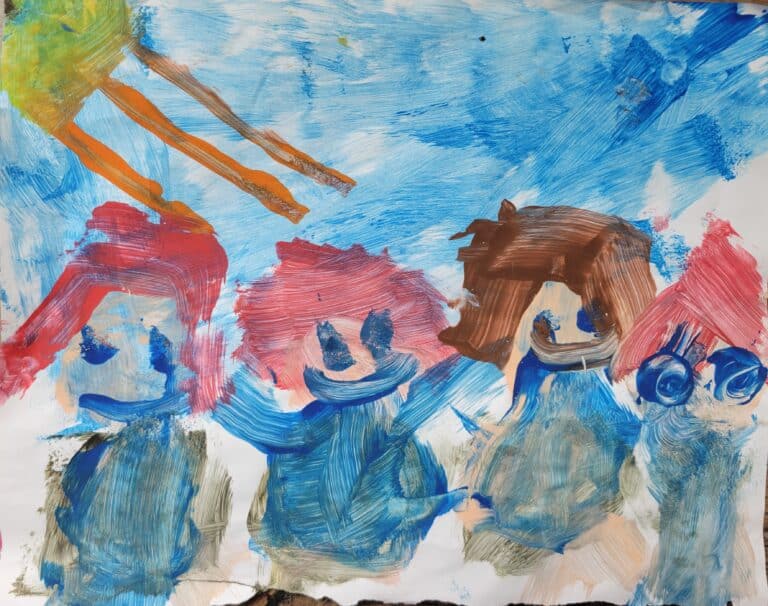
You might think that a mother’s attention to her children is something she can divide evenly and neatly. Four slices of pizza arranged on separate plates. Four children, four equal portions. But that’s not how it works. At least not in this household. Like any job, motherhood requires prioritizing and problem-solving. I am constantly making choices about who needs me most at any given moment.
Some days feel like a series of small betrayals. As I’m helping my eldest daughter with homework, I’m bouncing a cranky 2-year-old on my lap. Both want more of me than what I am providing. When I’m listening to a long, partially incoherent explanation of a dream from a 4-year-old, I’m half-aware of my 7-year-old waiting for me to notice her, quietly holding out a math quiz with a perfect score. My girls think I don’t notice them, that I’m not paying attention. I do notice. That’s the problem. I notice everything. I notice where my attention is going. And where it isn’t.
I’m constantly saying,
“Please, wait a minute. I’m helping your sister.”
“Hang on, just give a minute.”
“Do you really think right now is the time to ask me this? When your sister is screaming, and I’m cooking dinner?”
“I promise I’ll help you soon.”
“Just give me five minutes.”
“I will be right there!”
“There’s only one of me and four of you. I’m trying.”
My kids are forced to wait, to share, and to take turns even when they don’t want to. Sometimes they tell me that night or even the next day that their feelings were hurt because I didn’t listen to them. Or they remind me I promised to sew the hole they dug into their overly-loved bedtime stuffy and I haven’t done it yet. (True–it’s sitting near me on the desk as I write this.)
The guilt hums in the background of my life like the dishwasher that is always, always running. It’s there when I rush through bedtime without reading a book because I’m so worn out, so tired that I can’t muster up the energy or the patience. It’s there when I forget dress-down day, sign a form late, or realize I haven’t cuddled one of my girls in a couple of days. When I’m making their lunches before bed, I’ll remember that one of my middles never got to tell me the funny thing that happened at school, and my heart will bang in my chest as I feel the weight of it all. What will they remember? Which moments will calcify into memories for them?
Most nights when the girls are tucked in and sleeping, when the house is still enough, I can hear my own thoughts. I rifle through the day in my head. Who got the most of me today? Who got the least? This becomes who did I fail today? I worry that being needed by all of them means I am fully present for none of them.
Sometimes I see mothers with one or two children, and I consider what that life is like. I watch them, wistfully, and wonder quietly if I might have been a better mother with fewer children—if I would have had more patience and more time to give each daughter. But I don’t let myself linger there for too long. That isn’t my story, and there’s no point in dwelling on an alternate life. I chose to have four children, and much of the time that choice feels so full and right that I can’t imagine my life any other way. Still, there are days when guilt settles in. I know I give more time and attention to certain children, shaped by their needs in a given season of our lives.
And yet, there is so much good that exists in a home with four children. Like the little failures, I see the good, too.
The way the girls orbit each other.
The way they borrow comfort from their sisters when I’m busy.
The way love seems to move through the house, even when I’m not at the center of it.
Most days, our home feels warm and full in a way that’s hard to describe. It buzzes with life and love. My girls have built-in best friends and constant playmates. Even now, as I write in the quiet, I can almost hear their laughter and footsteps echoing down the hall. There is so much noise within these walls—joy and tears, chaos and comfort—but above all, our home feels alive. Maybe what I’m giving them, in my ever-imperfect way, is not constant attention but something else: a sense that life is shared, that love flows between all of us, that they can rely on themselves and each other.
I see the bonds and friendships forming. I see them growing into one another. My older girls read to the littles, and it’s a gift to both sides—the older ones glow with the pride of having an audience, and the younger ones feel special when the big girls devote time to them. Movie nights are anything but quiet, usually spilling into singing and dancing. When one daughter is lonely or scared, a sister is close by. Sometimes I tell myself they are learning resilience; they are learning to rely on themselves and on one another, instead of only relying on me. If all else fails, I’m hoping the sisterhood prevails.
Do we all wish for more alone time? Probably. I certainly do. Do my girls get frustrated when they’re asked to wait, when they feel overlooked, when their voices are lost in the noise? I’m sure they do. But I’m hoping that what lingers longer than the frustration is the love—the deep knowing that they belong to one another. No one will even know them as deeply and truly as their sisters. I have always loved this quote by Clare Ortega: “To the outside world, we all grow old. But not to brothers and sisters. We know each other as we always were.” There’s something magical about siblings that I feel even now with mine. It’s that magic that I hope they remember.
I still wish I had more hours, more focus, more of myself to give. But I’m learning that motherhood—at least this version of it—isn’t about keeping everything perfectly even. The slices don’t have to match as long as everyone is fed. I’m not a perfect mom. I make mistakes, lots of them. But my love is constant and overflowing. My love is steady and abundant. Mothers of one child and mothers of many know this quiet truth: love isn’t measured or divided. It stretches. It endures. And somehow, a mother’s love is always enough.



 by Carolyn Moore
 by HVFH Contributor
 by Christy Marshall