
 By Megan Honor Pesch
I pull my minivan up into the carpool lane at the special education preschool my daughter attends. Odessa comes running out to greet me, backpack bouncing and goofy grin wide, falling into my hug. After I buckle her in, I notice the odometer has just turned over to six digits. In these past five years, I have driven Odessa 100,000 miles. To and from appointments, to another state in search of better services, and back again when it didn’t work out. The minivan, with its Goldfish-crumbed seats, has been dented and scratched, run out of gas, and broken down once or twice. This old friend has carried us through tough terrain,1 and while there are still bumps, we are finally cruising on a much smoother road.
As a person who is deaf and autistic, Odessa lives inside profoundly rich worlds. The parts I am able to partake in are beautiful beyond description. The irony is that I once thought these “conditions” would cause her to be isolated, unhappy, and unfulfilled. Worried about her not being able to live up to her “potential,” I wasted so many of her days with well-meaning subspecialists, therapists, and clinicians, instead of basking in her glow.
In graduate school, I joined a book club of like-minded 20-somethings studying child development. Among this group of “experts,” none of us were truly authorities in child-rearing as we were not yet parents, we would ponder and attempt to use the great theorists—Erikson, Piaget, Bowlby—to our (limited) experiences and readings. I recall one book particularly vividly: Far from the Tree by Andrew Solomon, a gripping description of the lives of parents of children who were different from them: Little People born to typical height families, deaf/deaf babies born to hearing families, neurodivergent children born to neurotypical families. Each account was realistic, messy, moving . . . just like life. I was in awe of the parents in the book and frankly, scared to imagine myself one day in a similar situation. At my core, I was certain I would never be able to handle having a child so different or so distant from me.
As many do before starting a family, I imagined myself bearing well-behaved, academically gifted, tidy, and loving children. In the future, I would continue to rise in my career and also gracefully be ever-present for my imaginary offspring’s emotional and physical needs. We would be so close in our shared world. In retrospect, my naively dreamt offspring were bland, uninteresting, and flat—thank goodness I was so wrong.
A decade later in a dark operating room, Odessa came soaring into the world on the second push, born face first with her arm extended above her head, hand clenched in a teeny fist. Like a superhero flying through the sky or a protestor asserting her power at a march, Odessa was born ready for a fight. And, I now know that her fight has, in part, been getting those around her to recognize her extraordinariness.
Over the next two-and-a-half years as we began to learn about Odessa’s hearing loss and then later her autism, the remaining space in our lives began to fill with tears, worries, and appointments, blocking much of the light that was trying to shine in. As a pediatrician myself, I clung to the promise of “good outcomes” from early intervention. But with each diagnosis, I felt distance growing between my ideals for her future and the worlds where she naturally thrived and belonged. It has taken time to shift my focus from desperate attempts to “normalize” her communication and behaviors, to appreciating her vibrant self as she is.
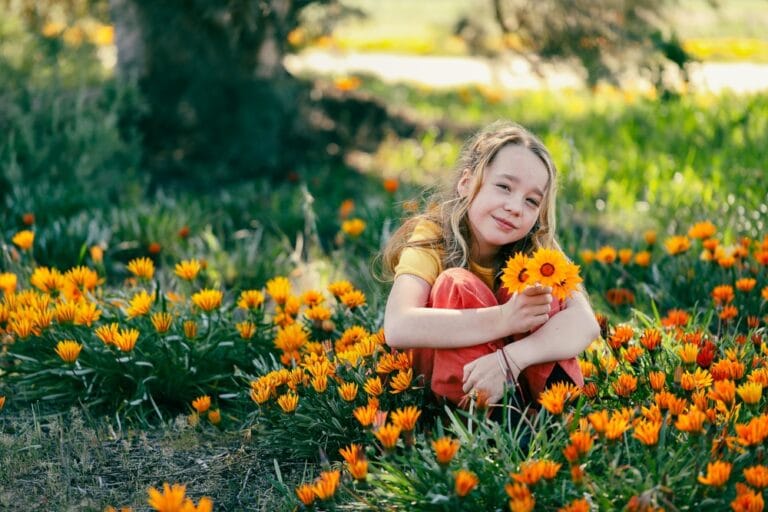
Odessa’s world is silent but not quiet or still. It is rambunctious with movement, vibrations, spinning, and jokes. Bright lights, the moon, and a starry sky nearly paralyze her with delight. Her communication is multidimensional–yes, she can speak a bit, but she also signs and dances, and touches and sings. She can convey her needs and feelings through a hug or a nod. Odessa’s world is brimming with joy, which she generously nuzzles or communicates not only with spoken words but in all dimensions.
It has taken me 100,000 miles to start to appreciate and cherish this journey. While I will never truly know what it is like to be her, I am able to observe her wonder. She is a curious and opinionated girl who has been trying to tell us all along that everything will be okay. As our family has shifted to following her lead, versus making her follow ours, she has blossomed socially, emotionally, and in communication. Despite all my training in child development, I will always be two worlds away, but I can still enjoy the ride.


 by Christina Young
 by Ellie Hunja