


When God made Grandma Whipple, He certainly made her one of the best. I remember the first time I saw her—in the kitchen, of course. Standing at barely five feet tall, with her smooth olive skin, white hair, and beautiful brown eyes, Grandma Whipple was full-blooded Italian. Meeting my future mother-in-law was a little intimidating, I admit. I was a 19-year-old girl about to marry one of Grandma Whipple’s seven sons. Our backgrounds couldn’t have been more different—me with my Irish heritage, and my new in-laws with New England roots.
But one of the first things I learned about Grandma Whipple, affectionally called “Ma” by her seven sons and growing number of daughters-in-law, was how big her heart was. She called me her daughter from the first. She never made me feel like an outsider, and I was now another member of her large family. My wedding wouldn’t have been complete without her gigantic platter of Italian wedding cookies, all handmade by her from scratch, and my new little home outfitted with a new set of curtains for every window.
Grandma’s family came to the United States of America from Southern Italy, from the
foothills of Mt. Vesuvius. They brought with them their down-to-earth common sense, a hard work ethic, and a love of good food. The kitchen was where Grandma Whipple reigned supreme, loudly directing her daughters-in-law and granddaughters through all the intricacies of a lasagna dinner. The grandchildren knew just what to do when they heard Grandma shout, “Manja! Manja!”
I quickly learned to appreciate the circumstances and situations that made Grandma
Whipple into who she was. She almost single-handedly raised her boys, a single mom
in the days when single moms weren’t given much credit for their impossible task. Her fingers were bent because of the jewelry work she did long into the night so that she could buy milk and bread for her sons. She also survived the loss of a younger sister and a 16-year-old grandson.
Another thing I learned to admire about Grandma Whipple was her courage and spunk. I don’t know how many times we’ve all heard her say, “I’ve got to say the truth!” And she would do just that—to anybody, anywhere. She wasn’t about to back down or back away from a confrontation if the occasion called for it.
Then came the babies. Grandma Whipple had 13 grandchildren and one great-
grandchild when our first child was born. Every new baby was just as special, just as much a beautiful miracle as the one before.
“Quant’e bella!” she would exclaim with her arms stretched out to take in another little one. I can see her in my mind now, after my third child was born, slowly making her way into our apartment to bring a pretty little newborn dress for my daughter.
And her love didn’t stop there; she loved them through the terrible twos, the troubled teenage years, the relationships, the weddings, the new jobs, and then the great-grandchildren. Did they have enough to eat? Did they have enough to pay the bills? Grandma wasn’t rich, but she had an old black pocketbook in her room where she kept her “extra” money. We were often recipients of the contents of that old pocketbook, one of the many practical expressions of Grandma Whipple’s
love.
And love, the greatest of all, is the best description of the legacy that Grandma Whipple left to her family. Her final days were marked by love as indeed, all her life had been.
We heard that she was suffering from cancer, and she had chosen not to pursue further treatment. Although we understood her choice, none of us were ready for her to go. Sons and daughters-in-law and grandchildren took turns staying with her, trying to do for her the things she could no longer do for herself. Even in her suffering, Grandma wanted to have a “fun party” to reward her granddaughters for the help they were giving her.
Grandma Whipple wanted her family to stay together even after her passing. That was one of her requests. On holidays, birthdays, or for no reason at all, we still
occasionally gather at her house. Even though she’s not there, her rocking chair is
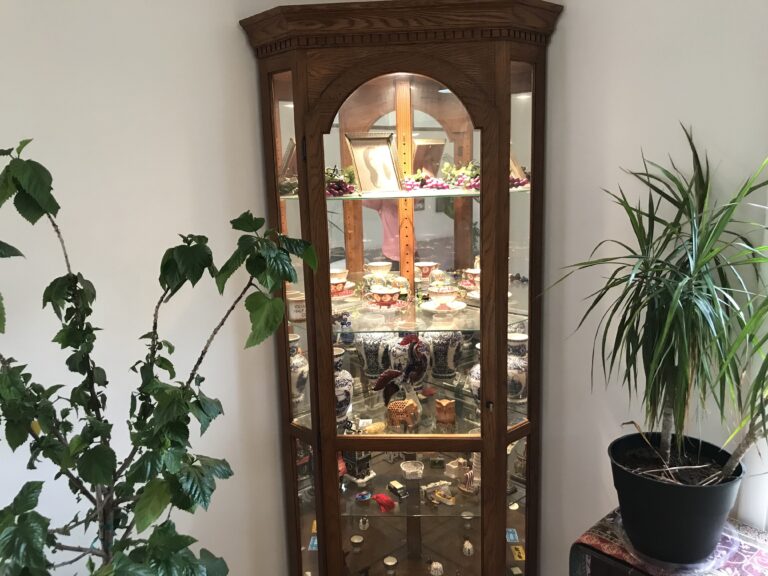
standing where it has always been. Her well-worn Bible is still on the table by her chair, and her collection of salt and pepper shakers still line the kitchen shelves. We try to make tomato sauce and meatballs just like she did, and we attempt pizza and lasagna by her unwritten recipes. No one can ever take her place, but I like to think that Grandma Whipple’s legacy lives on in my children–her grandchildren.

 by Jacqueline Miller

 by Lindsay Sledge