
A Gift for Mom! 🤍

When I speak at colleges about my own story of sexual abuse, I never forget how difficult it was for me to even speak the words, “I was sexually abused.” It took me an even longer time to believe it, or to understand it could happen to me. And what took so much longer than I ever could have predicted was to believe that I was sexually abused…and it wasn’t my fault.

Many survivors “know” that being sexually assaulted was not their fault. Now, I’m one of them. But the question I’ve worked to answer after a decade of “healing” and “processing” what happened to me is, “Well, then why didn’t I do something?”

I had heard this dozens and dozens of times — in my own head and with students who have opened up to me during my programs. Many victims of abuse, molestation and domestic violence often feel a guilt that they are not deserving of. For months after my voice teacher molested me, I beat myself up thinking, “Why did I do that?” wondering, “What was I thinking?” and assuming “Something must be wrong with me.”

It also took me a very long time to accept that a mentor and father figure in my life had violated our trusting relationship. I kept replaying the events that had occurred in my mind, telling myself, I must have done something wrong — why else would he have done this? I must have instigated something… I blamed myself, convinced that no one could take advantage of me if I had not invited it.

I couldn’t shake off this “shame” I felt no matter how hard I tried to forget what had happened. The more I tried to block my memories, the more anxious and confused I became. I became a space cadet — hardly feeling at all. It was how I protected myself. This way, I couldn’t feel the sense of loss and betrayal. I couldn’t feel the shame of still thinking this was all “my fault.” My numbness started to alarm my friends and family, to whom I insisted that nothing was wrong at all. I kept this secret hidden inside, burning in my gut, hidden from those I loved.

The more I tried to repress what had happened, the more anxious I became, until I couldn’t handle keeping these secrets locked up so tightly. Shocked, upset and overwhelmed I was living in three worlds — part of me functioning normally in school, keeping up my grades, and telling people I was “fine,” part of me replaying traumatic memories in my head, beating myself up for not saying no, for not running away, for not fighting back, and part of me in a numb, apathetic space of disconnect — a place I created in my head as a survival instinct. If I created a frozen, “numb” space to exist in, I could alleviate the sense of shame I felt.

When I turned 18, I finally spilled everything to my mother. I was so afraid of what she might say or if she would judge my actions. I was embarrassed to say words like “sex” and “molestor” and “rape” out loud, let alone with my mother. My mother was as shocked I was. But she still provided me with the one solid anchor that I needed. She told me it was not my fault. No matter what I told her I had done, what he had done, what details I could remember, or what I confided in her, she reassured me with the certainty only a mother can have: it was not your fault.

Reaching out to someone I knew loved me unconditionally calmed my anxiety. Telling someone what had happened made my “dark” secret come to light. I became open to viewing my abuse in a different way — I was willing to take some of the responsibility off of myself. My mother and I started reading about “trauma.”

I learned that in the face of trauma, you can have three responses: You can fight, flee or freeze. I could have immediately fought back against my abuser, yelling “no” or defying him in some way. I could have just ran in the other direction as fast as I could. But I was so shocked by everything that happened that I froze. Like a deer in the headlights, I couldn’t come to terms with the idea that a man that I trusted as my mentor could turn into such a monster in the blink of an eye. I mentally left the situation, disassociated from my body, and became a passive bystander to a trauma that my body was directly involved in.

I learned that the physical sensations of “guilt” register in the same way that “shame” and “helplessness” do in your body — so when a person feels helpless in a situation, the body automatically pairs that sensation with “guilt.” When you undergo any kind of trauma it causes a disturbance in your energy flow — suddenly, you are unable to feel those emotions that once came so naturally at a time. My body stopped breathing the same way it used to — a big knot of tension evolved in my chest and remained there like a cocoon. My thoughts became rigid — frightened to wander into past memories. I put up a daze like four safe walls that protected me from being consciously present in the abuse, and that daze stayed with me with or without him. I lived in a world separate from everyone else.

Reaching out not only gave me the blessing of compassion from others — it also informed me of what I had really experienced. I realized my “numb” response to my assault, my nervous energy, sweating fits and anxiety attacks were not something to be ashamed of, but rather, a proud and victorious survival strategy.

In a wonderful book, Waking the Tiger, Peter Levine writes, “All mammals automatically regulate survival responses from the primitive, non-verbal brain, mediated by the autonomic nervous system. Under threat, massive amounts of energy are mobilized in readiness for self-defense via the fight, flight, and freeze responses. Once safe, animals spontaneously ‘discharge’ this excess energy through involuntary movements including shaking, trembling, and deep spontaneous breaths. This discharge process resets the autonomic nervous system, restoring equilibrium.” 

Suddenly, I felt understood. Now, when I work with survivors, I help them realize that their reactions to trauma and assault are natural human reactions to be applauded. The real work comes from taking that nervous energy, which was formerly an essential trauma survival skill, and turning it into productive healing energy — energy that once redirected, can build a new, beautiful world for the survivor.

As a proud, once-frozen survivor, I finally see my world in color again, once I could find the courage to feel the sensations of being alive — however uncomfortable it might have felt in moments of trauma, guilt, shame and confusion. I protected myself in a traumatic situation by becoming numb to my emotions, but now the danger was gone, my abuser had left the picture long ago. Now, the work was up to me. I told myself “it wasn’t my fault” until I believed it. And once I felt these words resonate in my body, in my soul — I liberated myself. I had nothing to be ashamed of. And I had every right to reclaim my life, my aliveness, move on and experience the world in all of its radiant colors once again.

The biggest gift I can give to survivors I work with in my program now, is the gift of a world in color — alive with melancholy blues, angry reds, uncertain grays, but also one of ecstatic oranges, bright yellows, and deep rich purples. Once we let ourselves feel the “bad”, we make room for the “good”.

I was sexually abused. It was not my fault. In a traumatizing situation, I froze, while others might have fled or fought back. But with time and with confiding in those I trust, I have unthawed and faced what I’ve tried to forget. And with nothing to hide, nothing to regret or redo, and everything to look forward to in the future, I’ve allowed myself to move on, claiming my voice, speaking my truth.

As survivors, the most wonderful part of healing is moving from a helpless situation into a world of our own design. Now that we’ve relied on the instinctual survival skill of freezing,” we’ve kept our spirits in tact, and now, we’re unstoppable.

So what is shame? Shame is energy. As we turn that energy into energy that is rightfully ours, the energy of survival, pride and life, we become forces to be reckoned with.

Amy works directly with survivors of sexual assault and those healing from PTSD. Learn more about her college sexual assault prevention initiative here. 

So God Made a Grandmother book by Leslie Means

If you liked this, you'll love our book, SO GOD MADE A GRANDMA

Order Now!

Amy Oestreicher

Amy Oestreicher is a PTSD peer-peer specialist, artist, author, writer for The Huffington Post, award-winning health advocate, actress and playwright, eagerly sharing the lessons learned from trauma through her writing, mixed media art, performance and inspirational speaking. Amy has written, directed and starred in a one woman musical about her life, Gutless & Grateful, has flourished as a mixed media and acrylic artist, with her art in multiple galleries and mounting dozens of solo art shows, and continues to share her story through her art, music, theatre, workshops and writings. Amy’s “beautiful detour” has inspire her passionate desire to create and help others. Her writings have appeared in Washington Post and On Being with Krista Tippet, her story has appeared on the TODAY Show and CBS, and her one-woman show has been seen in theatres across the country, earning rave reviews and accolades since it’s BroadwayWorld Award-nominated NYC debut. Determined to bridge the gap of communication between wellness resources on college campuses and students, Amy devised storytelling programs especially for colleges and universities to address the issue. Amy is currently touring the country with her one-woman musical, Gutless & Grateful, her keynote presentations, workshops and signature talkbacks, which she has devised specialized versions for corporations, college campuses, survivors, healthcare professionals, and artists. She is leading mixed media creativity workshops to promote creativity as a mindset, an essential survival skill. Amy also offers private coaching to help others navigate their own beautiful detours. Visit amyoes.com for more information. https://www.amyoes.com/

When I Look In the Mirror, I See My Mother

In: Grief
Woman with mother smiling in older photo

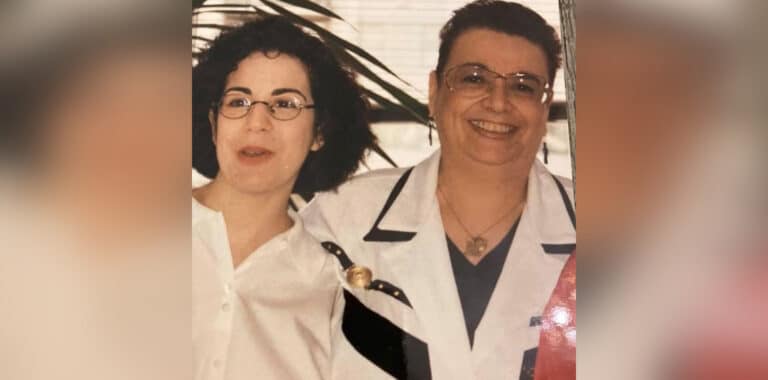
Recently, whenever I look in the mirror, I see a strong resemblance to my mother.  People always said I looked like her, but I never really saw it until now. I think it may be because you always think of your parents as being older than you are. At the age of 61, I am now only two years away from the age my mother was when she died. The only good thing about dying young is that everyone will remember you that way.  I have only known my mom as the vibrant, personable, and active woman she was. Well,...

Keep Reading

I Lost My Daughter on Mother’s Day: 3 Truths I’m Believing Today

In: Grief, Loss, Motherhood
Woman and young daughter smiling

Editor’s note: This post discusses child loss Child loss changes Mother’s Day. My 19-month-old, Julia, died suddenly on Mother’s Day in 2024. Three months later, her autopsy revealed she had B-cell Acute Lymphoblastic Leukemia (B-ALL, also known as SUDNIC). Julia died a week after we did an embryo transfer at an IVF clinic in an attempt to have a second child. We found out three days after Julia’s death that the embryo did not make it either. Six months later, we did another embryo transfer that succeeded, and I now have an 8-month-old daughter, Lucy Mei (“Mei Mei” means “little...

Keep Reading

I Miss Having Parents

In: Grief
Grown daughter posing between smiling parents

I have been living with the ache of loss for so long that I truly don’t remember what it feels like not to carry it. Sometimes it rests quietly beneath my ribs, dormant and almost polite. Other times it rises without warning—on an ordinary Tuesday afternoon, in the middle of a coffee line—and cuts straight through me. Today, it was a song. I was waiting for my coffee when “Pictures of You” by The Cure drifted through the café speakers. I hadn’t heard it in 20 years. In my twenties, it meant heartbreak—young love unraveling, relationships ending before they were...

Keep Reading

What No One Tells You about Losing a Sibling

In: Grief

Nobody tells you that when you lose a sibling, your entire childhood flashes before your eyes. There’s no better witness to what you experienced growing up than that one person who was standing nearby for all of it. And when they’re gone, a part of that childhood and a part of that story goes with them, because it was only ever known between the two of you. There’s no last chance to say, “Remember when?” or to laugh about the things that made you laugh to tears together, a million times at the kitchen table. There’s no last conversation about...

Keep Reading

Grief Didn’t Break Me, It Rearranged Me

In: Grief
Sad woman looking off to the side

I survived losing my father after his long, grueling battle with cancer. It was one of the most difficult seasons of my life. I had a front row seat to watch cancer pick him apart piece by piece. When you lose a parent, you lose a part of yourself. They say time heals all wounds, but you never stop missing the good ones, and there are days when it feels like it just happened. By the grace of God, I survived, but I will always miss my father. Then, almost a decade later, I lost the career that helped me...

Keep Reading

I’m Learning To Be Soft and Strong

In: Grief
Woman sitting and crying on floor

During the weeks we cared for my grandmother in hospice, survival mode felt necessary. There were medications to track. Visitors to update. Logistics to manage. I remember sitting on the couch that served as my makeshift bed and listening to the rhythmic hissing and puffing of the oxygen machine one night. While my mom showered off the day, I texted my sister updates and sent my husband a quick message of love. I could still smell the lavender candle we had lit earlier in the day to mask medical scents. The house was quiet, but my mind wasn’t. I was...

Keep Reading

The Legacy Our Mothers Leave Is In the Details

In: Grief
Woman's hands holding beautifully wrapped small gift

It has been two months and nine days since my mom passed away. The first several weeks were spent on the details and logistics of planning her service. She passed in December, so once her beautiful service had passed, I busied myself with the preparations for Christmas. By mid-February, I finally began to process some feelings of grief on a deeper level. The quiet of this less-busy season is allowing the grief to soak in a bit more. Not the big things; not the obvious, grief-heavy reminders that stop me in my tracks. Instead, I’ve been noticing the small things....

Keep Reading

You Never Get Over Losing Your Mother

In: Grief
Woman and grown daughter smiling

It’s been 10 years since I last heard my mother’s voice. Ten years since I could pick up the phone and ask a question I already knew the answer to, just to hear her say it anyway. Ten years since someone loved me in that very specific, unconditional, occasionally annoying way that only a mother can. My mom died in 2015. And while “passed away” sounds softer, more polite, the truth is that she left. Suddenly. Permanently. With no forwarding address. She was gone. What I’ve learned in the decade since is not what I expected. I thought the biggest lesson...

Keep Reading

My Husband Is By My Side Through Every Storm

In: Grief, Marriage
Man with arm around woman's chair

The year 2025 began as a quiet storm. I was slipping into the fog of depression while navigating the early chaos of perimenopause, and some days simply getting out of bed felt impossible. My thoughts felt dark and heavy, my body unfamiliar, my energy nonexistent, and my moods uncontrollable. And yet, in the haze, there was one constant: my husband. He noticed the subtle shifts I barely acknowledged. The sighs, the quiet retreats into myself, the moments I almost broke. Instead of judgment or frustration, he offered presence. He held space for my struggle without trying to “fix” it, and...

Keep Reading

Losing My Mom Shaped Me As a Mother

In: Grief
Woman hugging young child, back view

Becoming a mother has a way of bringing old wounds back to the surface, even ones you believed had healed. I never imagined grief would surface so strongly in my motherhood journey. I thought it was something you carried silently, something that faded with time. But becoming a mother felt like my loss rising to its feet and saying, I’m still here There are moments when I reach for my phone to call my mom, only to be met with the reminder that I can’t. I want to ask her if what I’m feeling is normal, if the exhaustion softens,...

Keep Reading