


“Don’t limit a child to your own learning, for he was born in another time.” – Rabindranath Tagore
Quietly communing with a loved one in the early morning hours is such an intimate and precious time.
Visiting with one’s grown child when all is dark and still is one of life’s purest pleasures.
I remember the conversation clearly.
My daughter’s husband, small children, and father were all asleep as we whispered and chatted.
She and I are both fidgeters by nature, unable to be still for long.
This inner restlessness must be remedied, and we are compelled by biology to get up at least once before our tea cups are emptied.
Each of us must walk to the microwave, place our cup inside, and push the 30-second button.
Once that interminable half-minute is over, we can then take our beverage back to the sofa and resume our fellowship.
Both narrow-shouldered and rail-thin, my daughter and I sit in identical postures, slightly hunched and clutching our chamomile in oversized mugs.
Each of us is ready and willing to spring into action should the need arise.
This is the attitude of anxiety.
I observe this similarity of pose and offer my apology.
I beg her pardon for whatever genetics or environmental factors I contributed that cause her to perch like a tightly coiled spring.
I tell her I am sorry for passing my anxiety on to her.
If it was challenging for me to deal with, how could she possibly cope?
“I like my anxiety,” my grown daughter says.
And I am undone.
My child challenged me to learn a new outlook.
She did not explain what she meant, but that morning, I discovered a different perspective.
Worriers such as I often feel certain of one single thing: that our worry will ward off evil and other troubles.
But the past year has proven this belief to be quite false.
Her husband, my son-in-law, took a bad fall while doing some tree work this past summer.
Although he had followed all safety precautions, the tree had broken, and he plummeted 30 feet to the ground.
Thirty feet is a long way to fall.
I was to get a text she had not wanted to send, and I hadn’t wanted to receive.
They were in the emergency department at Seattle Harborview Medical Center, the premier trauma center here in Washington State.
She was asking for prayers, which immediately brought me to my knees.
She let me know my son-in-law was injured, and the severity was as yet undetermined.
The question of whether or not he would ever walk again had not been answered.
I cried out to God for His mercy, healing, and guidance.
It was the only thing I could do.
How had this awful thing happened?
My daughter and I had both worried together about every tree her husband had climbed, every limb he had cut, and yet this constant concern had availed us of nothing.
Nothing at all.
Anxiety had been my fast companion since childhood.
My mother was a worrier as was her mother before her.
I passed this vague apprehension on to my innocent daughter.
Yet, she had made friends with her anxiety and had not felt the need to explain further.
Could peace and anxiety coexist in the same person?
My husband and I have both been awed by our daughter’s strength and poise as she navigates this difficult path.
My son-in-law is an accomplished athlete and one of the most humble people I know.
At the time of the accident, he and my daughter had both completed the Boston Marathon with plans to compete in the Abbott World Marathon Majors.
They were training constantly and scheduled to run in the Chicago Marathon in just a few months.
This was not to be.
They had failed to purchase cancellation insurance, so the fees they had paid were now forfeited.
Just one of the myriad disappointments that would compound the damage done by the accident.
Yet seven months and three surgeries after the fall, my son-in-law barely registers disappointment as one of his emotions.
He has zero resentment, no bitterness, and no regrets.
What he does have is integrity, perseverance, inner strength, and courage.
He is completely devoid of anxiety.
“It was just one of those things that you have no control over,” he explains.
And once again, I am undone.
From marching in place by his hospital bed to weaning himself completely off of his pain medications, my son-in-law has applied himself 100 percent in an effort to experience the best recovery possible.
He is walking, he is running, he is living, and he is loving his family.
While the rest of us are astounded, he shrugs it off.
“Why give it anything less than your best?” is his constant refrain.
He is not working in the field that he loves most as an EMT, but is back at work on light duty.
The physical limitations imposed on him by the accident are frustrating, but he bears them with grace and strength and applies himself to each project in his charge with precision and care.
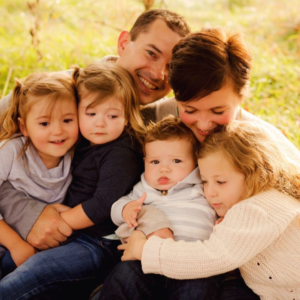
The children consider their father well for all intents and purposes.
He can’t lift them, it’s true, but the family has recently discovered a love of board games, and I have to laugh out loud when they send pictures of their antic-filled game sessions.
Laughter will always be good medicine.
The difficulties my children will face will be many, but they do not consider them to be unmanageable.
So why should I?
I am learning to observe their challenges with a new outlook.
Certainly, it pains me to see the hardships they must face, but I do not need to take on their obstacles as my own.
The future is unknown to any of us, and we all have many lessons still to learn.
My heart is grateful for my daughter and her family, and I appreciate the example they set for me and for others.
With God’s help, they will rise to meet the challenges before them. Together, they will learn the hard lessons that we all must learn in our own time.
“Do not be anxious about anything, but in every situation, by prayer and petition, with thanksgiving, present your requests to God. And the peace of God, which transcends all understanding, will guard your hearts and your minds in Christ Jesus.” Philippians 4:6-7



 by Eleanor Howard
 by Amy Brown