
 By Stacy Bronec
Like many young girls in the early 90s, I was obsessed with the Little House on the Prairie books. I collected the books, read them over and over, and even begged my family to visit Laura Ingalls’ house in DeSmet, South Dakota, on a family vacation when we drove across the Midwest.
Back then, I related more to Laura, her parents, and her sisters. As an 8-year-old, I wasn’t thinking about marriage—so the later books when she was married didn’t stick out as much to me. I pictured myself in place of Laura since we were about the same age. I loved reading about their way of life: living in a wagon with wild animals prowling around and living off the land. It was all so foreign to me in the late 20th century with a solid roof over my head.
RELATED: Marrying a Farmer Isn’t What I Expected
Today, I find myself relating to Laura in a new way, a way I didn’t appreciate back then.
In an unexpected adventure of my own, I found myself on the prairie, married to a farmer.
The same as Laura married her farmer, Almanzo—her beloved, “Manly.” Now, I’m living my version of Little House on the Prairie.
In many ways, a lot has changed since then. Tractors have replaced plows pulled by horses. And each tractor is equipped with a computer, doing a lot of the work based on technology instead of the back-breaking labor of Manly’s time. Farming now is leaps and bounds ahead of what Almanzo could have ever dreamt about.
But the love of the land, despite the hardships? That part hasn’t changed.
I imagine Manly lying in bed next to Laura, his brow furrowed in the dark, praying for rain after years of dry seasons, hoping this year would be different. I picture Laura reaching her hand across the mattress to grip his well-worn hands. The only thing she could offer him was support, love, and prayers.
In my own farmhouse, I see the worry stretch across my farmer’s face as we face another year of drought.
He confides in me how stressed he is about the dry fields and the rising cost of inputs. Both things we cannot change.
RELATED: Even When it’s Hard, the Farmer Will Not Quit
I squeeze his well-worn hands. I listen and worry, feeling helpless—as I imagine Laura did.
The final lines of “The First Four Years” end with Almanzo singing, “You talk of mines of Australia, they’ve wealth in red gold, without doubt; but ah! there is gold in the farm, boys—If only you’ll shovel it out.”
In a different century, my farmer wakes before the sun, puts on his work clothes, then looks toward the horizon. Hope fills his face with the promise of a new day.
Then he goes out to do what he loves. The land calling to him.


 by Deanne Frieders
 by Nicole Burke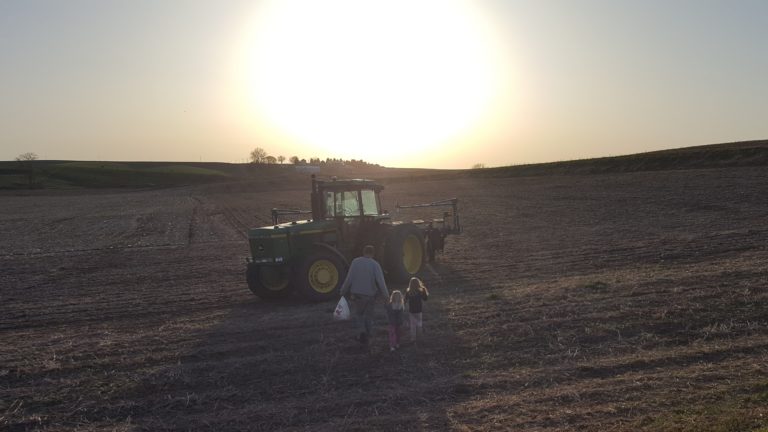
 by Melinda Tietsort