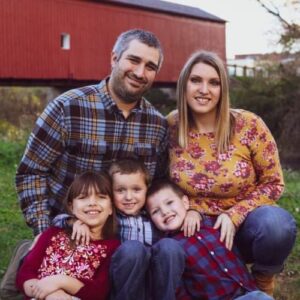

 By Nicole Ball
When you picture raising kids, you imagine the expected moments—birthday parties, scraped knees, school concerts, teenage moods, and one day watching them step into adulthood. What you don’t picture is standing in a hospital hallway, holding your breath, wondering if your child will choose to stay alive.
I never imagined that would be part of my story.
I also never imagined how much love would change me.
My youngest child came out as transgender during a season of our lives that was already full of change. At first, I didn’t know what to do with the information. I felt shock, fear, confusion, and a deep ache for the child I thought I understood so well. Suddenly, the parenting roadmap I had relied on felt erased.
We wanted to be supportive. We asked questions, showed up for therapy, listened to professionals, joined support groups, read what we could. But underneath our efforts, part of me still hoped that with enough time or guidance, things might return to “normal.” I didn’t yet realize that the only thing needing to change was my understanding of love.
Then came the day that shattered every assumption I held.
My child—still called Katelyn at the time—made a plan to end his life. We admitted him to the psychiatric unit at Cincinnati Children’s Hospital, and watching him walk away down that hallway broke something inside me. I remember the coldness of the air, the quiet hum of hospital lights, and the way my heart seemed to fall into a place I didn’t know existed.
In that moment, the only thing that mattered wasn’t my fears or my confusion. It was simply this: My child deserves to live. My child deserves to be loved exactly as he is.
And if anything needed to change, it was me.
Before this journey, I thought loving my kids meant guiding them, preparing them, keeping them safe, keeping them close. But love, I learned, also asks us to stretch. To grow. To loosen our grip on who we thought our children would be and make room for who they truly are.
Loving a transgender child doesn’t mean you wake up one morning with all the answers. It doesn’t mean the fear disappears. It doesn’t mean the path becomes easy. What it does mean is that you show up anyway.
Some days looked like learning new language.
Some days looked like advocating in doctors’ offices or schools.
Some days looked like sitting quietly next to my child so he knew he wasn’t alone.
Most days, it looked like choosing love over and over again, even when I was scared.
I began to realize the real question wasn’t, How do I understand everything about gender identity? It was, How do I make sure my child feels loved, supported, and safe in this world?
And when I focused on that, everything began to shift. The fear didn’t disappear, but it stopped taking the lead. Love took its place.
One of the most unexpected gifts of this journey is how it expanded my capacity to love. I used to believe my “circle of love” extended only to those closest to me—family, friends, people who felt familiar and comfortable.
But when you widen that circle to include someone different from what you expected, something beautiful happens. You grow. You soften. You learn to see people the way love sees them—not through fear or misunderstanding, but through connection and dignity.
Loving Kaine exactly as he is didn’t just save him—it changed me.
It expanded my compassion.
It taught me how many people simply need room to be themselves, without apology and without fear.
And isn’t that what all of us want?
To be held gently in the places where we feel vulnerable?
To know we belong with the people we love?
Today, my son Kaine is a thriving 21-year-old art student. He is creative, funny, thoughtful, and resilient. He is living a life that reflects who he truly is, and that is a gift I will never take for granted.
I believe he is here today because so many people—family, friends, professionals, and community members—chose love over judgment. They chose to see him. They chose to support him. They chose to stay beside him.
And I chose to let love lead the way.
If you are standing at the edge of your own unknown—afraid, unsure, grieving the expectations you once held—please hear this:
You do not have to have this all figured out.
You do not have to understand everything in order to love your child well.
You do not need the perfect words.
You just need to show up.
You need to listen.
You need to let your child know they belong with you.
Love will not erase every challenge. But love creates the foundation for healing, resilience, and hope.
And sometimes, love truly does save lives.
I’ve seen it happen.


 by Shelby Spear
 by Laura Bagnarol