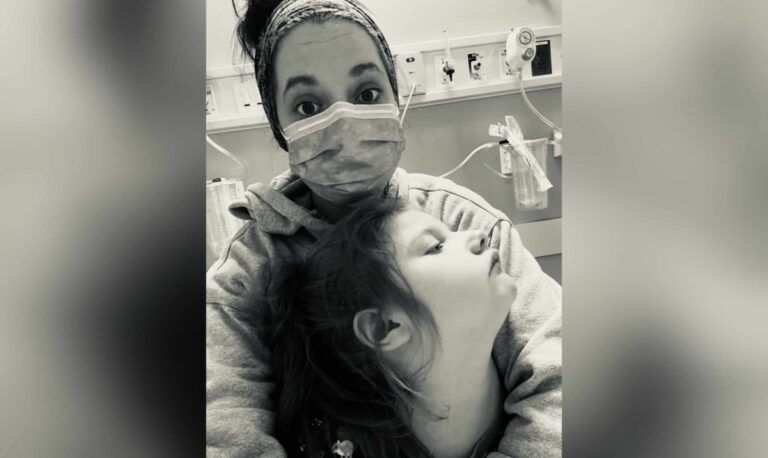



The last time I took the girls to the children’s museum, my toddler was playing at the LEGO table, and I saw a little boy about 7 or 8, stop playing to look at my visibly disabled child.
Now, this isn’t unusual. Stares and looks have become a norm for us when we are out. I know people look at her and are full of questions. Sometimes, it’s to the point that it feels like an elephant in the room. I know you see her, you stopped what you were doing to look over. I see you staring, and I know you have questions. Sometimes I wonder if I should just break the ice and blurt out, “She has cerebral palsy! She had a stroke in utero!” But that feels a little crazy.
More often than not, we get general questions like, “Oh, how old are your babies?”
“They’re just over a year old.”
Now, I know you have more questions. She doesn’t look like she’s a year old, like her twin does. She is small. She doesn’t make eye contact like a 1-year-old, or smile, or sit, or even hold her head up. She is excessively floppy. She is wearing oxygen. There is a good chance you didn’t even realize they’re twins because they’re not the same size and developmentally in completely different places. I know you have more questions. So just ask. Please, it’s okay, ask.
Anyway, the little boy at the museum . . . I didn’t expect him to say anything. Most kids don’t, at least not to me. Sometimes, I overhear them asking their parents “What’s on that baby’s face?” etc. But most people in general, adults included, don’t ask. But this kid at the LEGO station looked back and forth between my daughter and me and asked me, “What happened to your baby?”
I was honestly so impressed by the kindness and compassion in his voice and face. And the sincerity of the words he chose. I was so happy to give him a simple, age-appropriate response. And if he would have had follow-up questions, I would have been happy to answer them too.
He very well could have asked me, “What is wrong with your baby?” which, unfortunately, I have been asked numerous times by grown adults. There was a man in particular—I will never forget the way he looked at her when he asked me what was “wrong” with my baby.
It was in the early days of being home from the NICU, she was so small, her shunt was fresh and took up a large area on her tiny little skull, she had stitches on her head, posturing oddly in my arms. I’ll admit, she may have looked a tiny bit intimidating. But, he almost looked disgusted, or like he feared his son was going to catch whatever she had if they got too close. Don’t ask what’s wrong with her. She’s just different, she’s not broken or contagious.
I can’t speak for all parents of kids with disabilities, but I want to answer your questions or your kids’ questions. I want to spread awareness for kids like her. I want to normalize disability and reduce the fear that accompanies being around kids who are not typical and visibly different. Knowledge reduces the fear of the unknown and fosters acceptance. So ask your questions.
Don’t silence your child’s curiosities, and don’t tell your children not to stare. Don’t teach your child to actively avoid children who are different. I love that your child is curious about mine. Instead of “don’t stare,” tell them to wave or tell them to say hi because that is probably what you would do if you saw your child staring at a “typical” baby or child. Say, “I don’t know the answer to that question, maybe we should ask,” if your child asks you something you don’t know the answer to.
And if you don’t know what or how to ask, consider what exactly you want to know, and ask about that. “Why does she wear oxygen?” “What is on her head?” Or, I’d be happy to answer, “What’s her diagnosis?” And if you want to be really safe with a general question, you can ask, “What’s her story?” This allows parents to give as much or as little information as they wish. As long as someone sounds genuine and sincere, I am happy to talk.
My child is not something to fear. She is not someone to avoid. She’s not scary, I promise. She is sweet, loving, cuddly, and has the most precious smile. And one day, when she is older, she will just want to be accepted. And I want that for her too, so please, let’s make disability less scary, ask your questions.


 by Cara Arnold