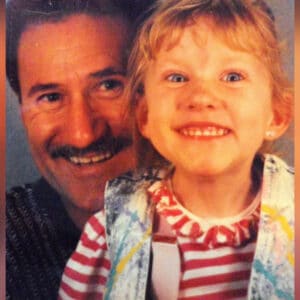

 By Brittany Moore
I was talking with my dad the other day about an upcoming Disney trip with our kids. I told him all we planned to do while we were there and how excited the kids were. He sat and listened, taking it all in. And then he said something that put a lump in my throat.
“I’m so glad you’re able to give your kids the life that I couldn’t.”
He went on to say he still carries some guilt–that he wishes he could have done more, taken us on trips, given us experiences he couldn’t. Hearing that broke my heart.
You see, my mom stayed home, and my dad worked multiple jobs just to make ends meet. We didn’t have a lot of money. My siblings and I never wore name-brand clothes, and we didn’t have the newest toys. Fine dining was Taco Bell’s dollar menu. We waited for movies to reach the discount theater. And after spring and summer breaks, hearing about other kids’ vacations made us realize how different our experiences were. We didn’t have those stories to share.
And in our adult years, we joked with him about it—the way we grew up, the limits of what we could afford. At the time, it felt lighthearted. But now I understand how much heavier it must have felt for him, and how I carried a quiet guilt too, not for how we grew up, but for ever reducing it to surface-level details.
But that’s not the full story.
He always did his best with what he had. I remember the small things that, at the time, felt simple but now feel sacred: trips to the Dollar Tree where we could each pick out one toy, ice cream cones from Dairy Queen, root beer floats from A&W, or spontaneous trips across town for homemade milkshakes. And because we understood money was tight, those moments taught us something deeper than enjoyment—they taught us gratitude and that what mattered most wasn’t what we were doing, but doing it together.
My dad had a way of making ordinary life feel extraordinary. I remember him bringing home brown paper bags, telling us he had spotted one on the side of the road and pulled over to pick it up. He would open it and say it was filled with all of our favorite candy. He had such a beautiful way of storytelling that we believed him every time. I’ll never forget the shock and excitement we felt.
That same joy carried through everything he did with us. He’d wake us up singing, “Let’s rise and shine and give God the glory, glory!” and we’d dance around the house while he played “Froggy Went a-Courtin’” on the guitar. We planted seeds in the garden and waited for them to grow, fell asleep in his lap on summer afternoons while he mowed the grass, and rode with him as he pointed out streets and stories from his childhood. Even ordinary drives became something we looked forward to.
He met each of us in our own way—singing songs to teach us colors, letting us put bows in his hair, taking us fishing, and turning silly competitions into something we all loved, like who could make the most ridiculous animal noises (he always joined in). He also gave us constant emotional support, never missing an opportunity to hug us, tell us he loved us, or offer advice, always with seamless analogies that made even the hardest lessons make sense. Above all, he led us to Christ through both his teaching and the way he lived, making faith a steady and natural part of our everyday lives.
And somehow, in the middle of all those moments, I didn’t fully understand what it took for him to make them happen. When he was home, the time he gave us felt so complete that we hardly noticed the long hours he spent away. Looking back now, I see it clearly: the early mornings, the late nights, the constant responsibility of providing. It wasn’t until I got older that I began to understand the weight he was carrying. And with that understanding came a new awareness of how deeply those sacrifices shaped not just his decisions, but the foundation of our entire childhood.
But what I understand now is that none of that would have existed without who my dad was.
And those sacrifices didn’t stop there. In his 40s, he went back to school to get a teaching degree while continuing to work multiple jobs, driven by a desire to provide more for us and have steadier hours. The sacrifices were quiet but enormous, the kind you only fully understand in hindsight.
Even then, he never stopped showing up. Any free time was never about himself. He gave up personal comforts and hobbies, anything that pulled him away from investing in others. It wasn’t just something he did, it was the way he lived—steady, intentional, and fully selfless.
And that hasn’t changed.
Even now, he is there for us, for our children, and for anyone who needs a helping hand. He gives so much to so many people and never asks for anything in return. He’s on the sidelines cheering at games, stepping in to help without being asked, and listening with his full attention. He notices the little things, celebrates small victories, and makes everyone around him feel seen, cared for, and grounded just by being near him. That same presence extends beyond our family; he shows up for neighbors, friends, and anyone in his life who needs support. If someone needs help, he’s there. This is the kind of man he is, a constant presence you can always count on.
Looking back over the experiences we had—and even the ones we didn’t—it’s clear how much they shaped me as a person and as a parent. Vacations and elaborate experiences are wonderful, and I am so grateful to be able to give those to my own children, but it was the sacrifices, everyday love, and steady presence that made our childhood rich.
Now, as I create memories with my own kids, I see it so clearly. It’s the small, ordinary moments that stay with you forever. Friday night movie nights, impromptu dance parties, inside jokes, and made-up songs we sing on repeat. It’s cuddles with Mommy before bed and playing monster with Daddy. These moments are the real wealth of a family, just like they were in my own childhood.
No, we didn’t grow up with luxury, but what we had was far richer than anything money could buy. Because in the end, the most valuable thing he ever gave us was himself, and when I think of my childhood, that’s what I’ll always remember most.


 by Rachel Zeko
 by Leslie Means
 by Valli Vida Gideons